AI Trading Strategies 2026: Build Smarter Algorithmic Systems
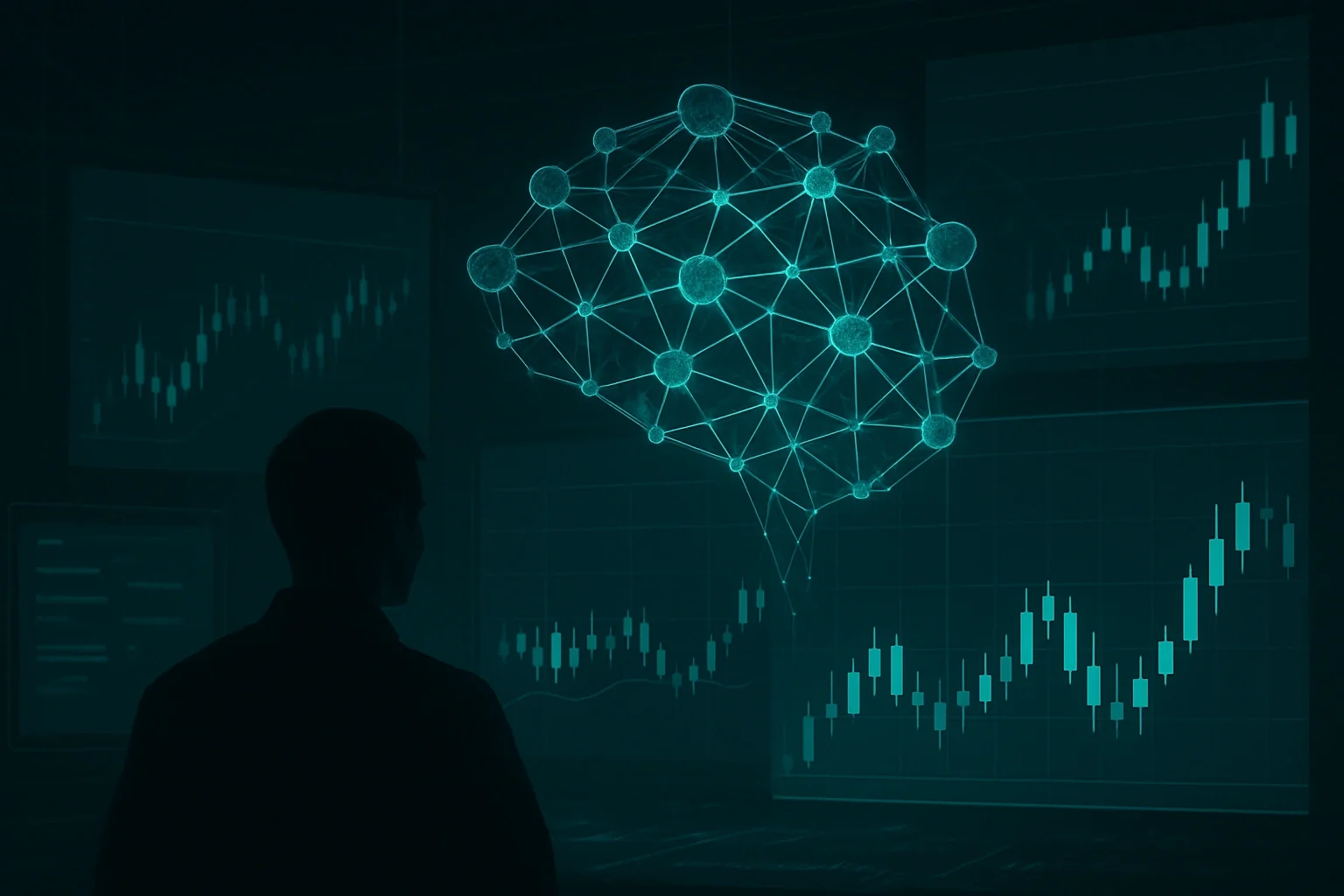
Learn how AI trading strategies work in 2026. Step-by-step guide to building algorithmic systems with machine learning, risk control, and real examples.
Introduction
Artificial intelligence is redefining how trading strategies are built and executed in 2026. As financial markets become more volatile, fragmented, and data-driven, traditional rule-based systems are rapidly losing relevance.
Today's AI trading strategies go beyond automation. They analyze complex datasets, adapt to changing market conditions, and continuously improve decision-making in real time.
This guide provides a complete breakdown of AI trading strategies in 2026, including how they work, what technologies power them, and how to implement them step by step.
What Are AI Trading Strategies?
AI trading strategies are algorithmic systems that use machine learning and advanced statistical models to:
- analyze market data
- detect patterns and anomalies
- generate trading signals
- optimize performance through continuous learning
Unlike traditional bots, AI-based systems are adaptive. They do not rely on fixed rules but instead adjust their behavior based on evolving market conditions.
Key Data Sources Used in AI Trading
Modern AI strategies combine multiple data types:
- historical price data (OHLCV)
- high-frequency tick data
- order book and liquidity data
- news and sentiment analysis
- on-chain data (for cryptocurrency markets)
This multi-source approach improves prediction accuracy and robustness.
Why Traditional Trading Strategies Are Becoming Obsolete
Rule-based systems struggle in today's environment due to several structural changes:
1. Increased Market Complexity
Markets are influenced by macro events, algorithmic flows, and fragmented liquidity across exchanges.
2. Faster Execution Environment
Opportunities appear and disappear in milliseconds, making static strategies ineffective.
3. Regime Shifts
Markets constantly switch between:
- trending conditions
- range-bound behavior
- high-volatility phases
Traditional strategies cannot dynamically adjust to these changes.
Core Technologies Behind AI Trading Strategies
Understanding the underlying technologies is essential for building effective systems.
Deep Neural Networks for Pattern Recognition
Deep neural networks (DNNs) are used to identify complex patterns in large datasets. They can detect nonlinear relationships and hidden signals that are not visible through standard indicators.
Typical applications:
- price pattern recognition
- volatility regime detection
- correlation analysis across assets
Transformer Models for Market Prediction
Transformers are increasingly used in financial modeling due to their ability to process entire sequences of data simultaneously.
Key advantages:
- capture long-term dependencies in price movements
- understand contextual transitions between market phases
- assign dynamic importance to different signals
They are particularly effective for short-term forecasting and sequence modeling.
Reinforcement Learning for Strategy Optimization
Reinforcement learning (RL) enables trading systems to learn through interaction with the market.
The model:
- takes an action (buy, sell, hold)
- receives feedback (profit or loss)
- adjusts its behavior to maximize rewards
Common use cases:
- position sizing
- trade execution timing
- dynamic parameter optimization
Probabilistic Models for Risk Management
AI trading systems rely on probabilistic methods to quantify uncertainty.
These models help answer:
- how reliable is a signal
- what is the expected distribution of returns
- how risk changes under different conditions
This approach enables more precise and adaptive risk control.
Key Features of AI Trading Strategies in 2026
Adaptive Market Regime Detection
AI models automatically identify whether the market is trending, ranging, or highly volatile, and adjust strategy behavior accordingly.
Volatility-Aware Execution
Instead of using fixed position sizes, AI dynamically adjusts exposure based on predicted volatility and risk conditions.
Multimodal Data Processing
Modern systems integrate multiple data streams:
- price and volume data
- sentiment from news and social media
- order book dynamics
- blockchain metrics
This improves decision accuracy and reduces reliance on any single signal.
Continuous Learning and Model Updating
AI systems are designed to retrain incrementally using new data, allowing them to adapt without losing historical knowledge.
How to Build an AI Trading Strategy: Step-by-Step Guide
Step 1: Define the Strategy Objective
Start by clearly defining your goal:
- scalping, intraday, or swing trading
- target market (crypto, forex, equities)
- time horizon
Example: predicting short-term Bitcoin momentum.
Step 2: Collect and Prepare Data
Gather high-quality datasets:
- historical price data
- order book data
- sentiment data
Data quality is critical. Inaccurate or incomplete data will significantly reduce model performance.
Step 3: Perform Feature Engineering
Transform raw data into meaningful inputs:
- returns and log returns
- volatility indicators
- volume spikes
- sentiment scores
Well-designed features often have a greater impact than model complexity.
Step 4: Select the Appropriate Model
Choose models based on your objective:
- neural networks for pattern recognition
- transformers for sequence prediction
- reinforcement learning for decision-making
In practice, hybrid systems often deliver the best results.
Step 5: Train and Validate the Model
- split data into training and testing sets
- avoid data leakage
- evaluate performance across different market conditions
Step 6: Backtest the Strategy
Backtesting should include:
- multiple market regimes
- realistic transaction costs
- slippage and execution delays
Robust backtesting reduces the risk of overfitting.
Step 7: Implement Risk Management
Include strict risk controls:
- maximum drawdown limits
- dynamic position sizing
- stop-loss mechanisms
Risk management is essential for long-term stability.
Step 8: Deploy and Monitor
- start with paper trading
- monitor live performance
- retrain models regularly
Continuous monitoring ensures the strategy remains effective.
Real-World Examples of AI Trading Strategies
Regime-Adaptive Momentum Strategy
Combines transformer models for trend detection with reinforcement learning for position sizing.
AI-Based Market Making
Predicts liquidity and spread changes to dynamically adjust bid and ask quotes.
Sentiment-Driven Trading Strategy
Uses natural language processing to analyze news and social media sentiment and react to market-moving events.
Multi-Agent Trading Systems
Multiple specialized models handle different tasks:
- signal generation
- execution
- risk management
- capital allocation
Their outputs are combined into a unified strategy.
Common Mistakes in AI Trading
Overfitting Models
Strategies that perform well in backtests but fail in live markets due to excessive optimization.
Ignoring Data Quality
Low-quality data leads to unreliable predictions and unstable performance.
Excessive Model Complexity
More complex models do not always produce better results and can be harder to maintain.
Lack of Risk Management
Even accurate models can fail without proper risk controls.
Failure to Adapt to Market Regimes
Strategies that do not account for changing market conditions tend to degrade over time.
Best Practices for Implementing AI Trading Strategies
- prioritize data quality over model complexity
- use hybrid modeling approaches
- validate strategies across multiple market conditions
- continuously retrain and update models
- monitor performance in real time
The Future of AI Trading
In 2026, AI is no longer an optional enhancement but a foundational component of trading systems.
Key trends include:
- fully autonomous trading systems
- real-time adaptive strategies
- integration of alternative data sources
- increased use of multi-agent architectures
AI-driven strategies provide a structural advantage by combining speed, adaptability, and predictive intelligence.
Conclusion
AI trading strategies represent a fundamental shift in how financial markets are approached. Unlike traditional systems, they are capable of learning, adapting, and optimizing in real time.
As markets continue to evolve, traders who adopt AI-driven approaches will be better positioned to manage risk, identify opportunities, and maintain consistent performance.
The future of trading is not just automated — it is intelligent.
Put these ideas to work, let an AI agent trade for you.
Get started →