AI Agents in Crypto: Use Cases, Examples, and Why They Matter in 2026
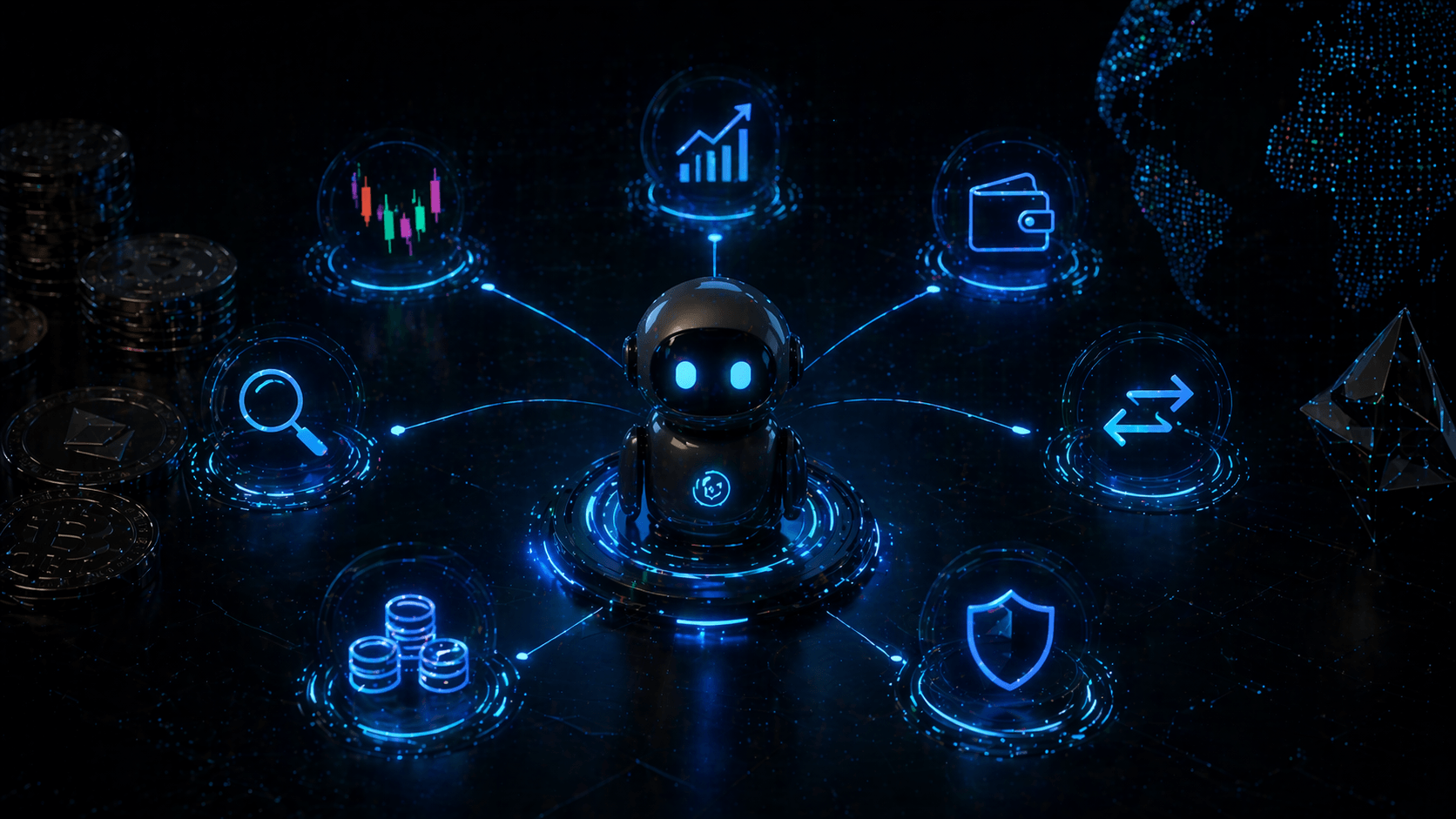
Explore AI agents in crypto, real use cases, and development examples. Learn about AI agent tokens, projects, and how they are shaping crypto markets in 2026.
The crypto market never sleeps — but you do. That fundamental mismatch between 24/7 markets and human limitations has driven traders toward automation for years. First came simple trading bots with rigid if-then rules. Now, a new wave is reshaping the landscape: AI agents in crypto. These autonomous systems don't just execute predefined scripts — they reason, adapt, and make decisions in real time.
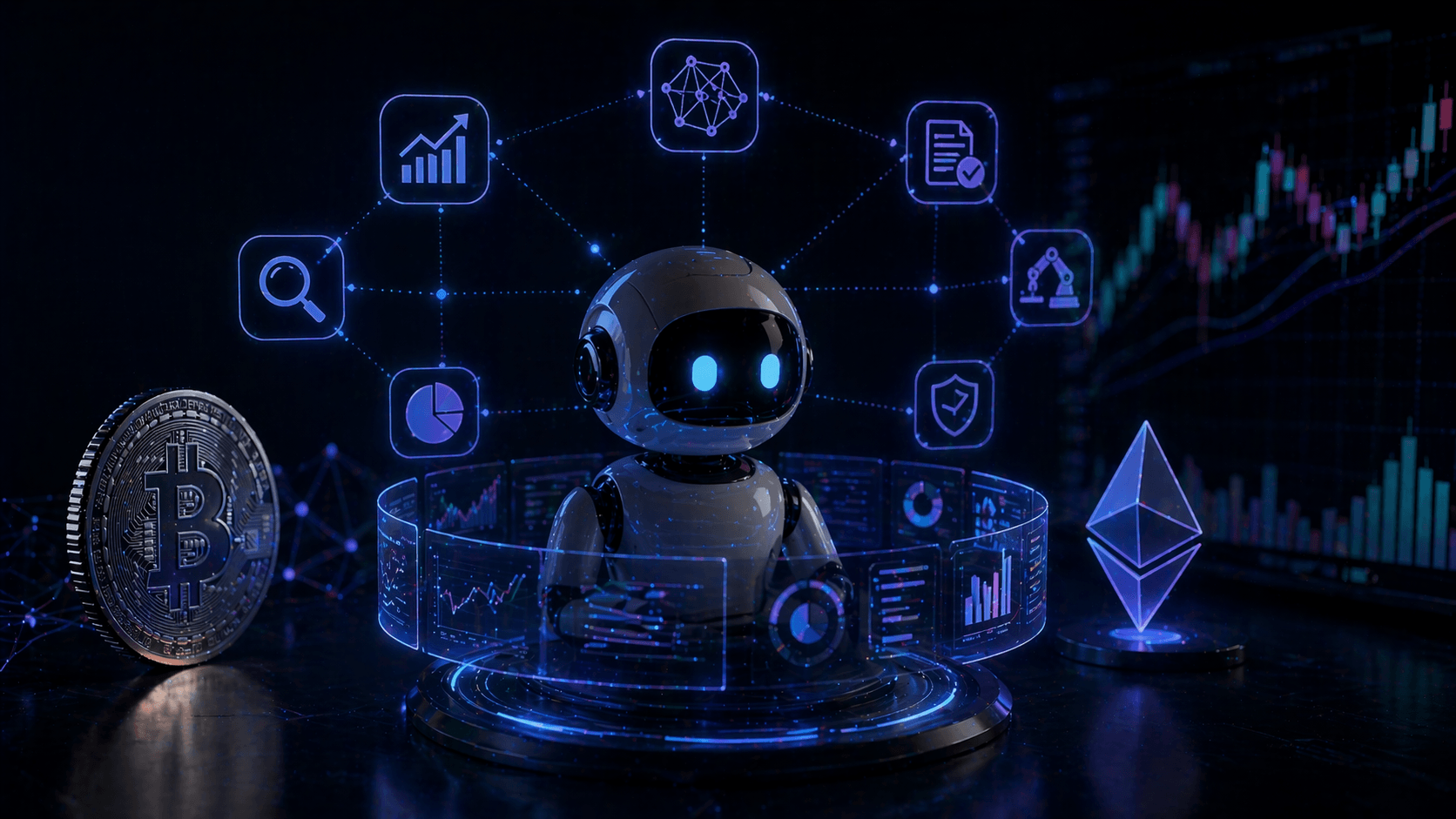
But what exactly are crypto AI agents, and how are they being used across the ecosystem? In this guide, we break down the real use cases, separate hype from substance, and explore where AI agent crypto projects are heading next.
What Are AI Agents in Crypto?
An AI agent is an autonomous software entity that perceives its environment, processes information, and takes actions to achieve a goal — with minimal human intervention. In the crypto context, that means an agent that can monitor markets, interpret data, and execute trades or other on-chain actions on your behalf.
The key difference between an AI agent and a traditional trading bot is reasoning. A bot follows a script: "If RSI drops below 30, buy." An AI agent evaluates multiple signals — price action, volume patterns, market sentiment, on-chain data, even macroeconomic news — and decides what to do based on a broader understanding of the situation. It can adapt its strategy when market conditions change, something a hardcoded bot simply cannot do.
This distinction matters because crypto markets are notoriously volatile and context-dependent. A strategy that works in a bull market can destroy capital in a sideways chop. AI agents can recognize regime changes and adjust accordingly.
Core Use Cases for AI Agents in Crypto
The agent AI crypto space spans far more than just trading. Here are the primary areas where AI agents are making a tangible impact.
1. Autonomous Trading
This is the most obvious and most demanded use case. AI agents analyze price charts, order books, funding rates, and sentiment data to execute trades autonomously. Unlike simple bots that rely on a single indicator, trading-focused AI agents can:
- Combine multiple strategies — momentum, mean reversion, and trend-following simultaneously
- Manage risk dynamically — adjusting position sizes based on volatility and portfolio exposure
- React to breaking events — parsing news feeds and social signals in seconds, not hours
- Learn from outcomes — refining their approach based on what worked and what didn't
The best implementations let traders define their strategy in natural language ("trade BTC with moderate risk, focus on swing trades, avoid overexposure during low-volume periods") and the agent handles the technical execution. This no-code approach removes the barrier that kept algorithmic trading exclusive to developers and quant teams.
2. DeFi Yield Optimization
Decentralized finance protocols offer yield opportunities across hundreds of pools, vaults, and farms. Manually tracking APYs, rebalancing positions, and avoiding impermanent loss is a full-time job. AI agents in DeFi can:
- Monitor yield rates across protocols in real time
- Automatically move funds to higher-yielding opportunities
- Factor in gas costs and slippage before executing
- Assess smart contract risk to avoid rug pulls and exploits
This use case is particularly compelling because the complexity of DeFi creates an information asymmetry that AI agents are well-positioned to exploit.
3. Portfolio Management and Rebalancing
For traders and investors managing diversified crypto portfolios, AI agents serve as autonomous portfolio managers. They maintain target allocations, execute rebalancing trades when positions drift, and can incorporate macro signals to shift between risk-on and risk-off postures.
Unlike a static rebalancing bot that triggers at fixed thresholds, an AI agent can evaluate whether a drift is temporary noise or a fundamental shift — and act accordingly.
4. On-Chain Analytics and Alpha Discovery
Some AI agents specialize in scanning blockchain data for actionable signals: whale wallet movements, unusual token transfers, smart money flows, and liquidity shifts. These agents surface opportunities that would take a human analyst hours to find, compressing the alpha discovery cycle from days to minutes.
5. Security and Risk Monitoring
AI agents can continuously audit wallet activity, flag suspicious transactions, and monitor smart contract interactions for anomalies. For institutional and high-net-worth traders, this layer of autonomous security is becoming essential.
AI Agents vs. Simple Trading Bots: A Critical Distinction
The market is flooded with products calling themselves "AI" when they are, at best, rule-based bots with a chatbot interface. Here is what actually separates them:
| Feature | Traditional Bot | AI Agent |
|---|---|---|
| Decision-making | Predefined rules | Dynamic reasoning |
| Adaptability | None — same logic always | Adjusts to the market regime |
| Input complexity | 1-3 indicators | Multiple data streams |
| Strategy creation | Code required | Natural language possible |
| Learning | No | Continuous improvement |
| Context awareness | Minimal | Broad market understanding |
The practical impact is significant. A bot will keep executing a breakout strategy during a ranging market and bleed capital. An AI agent recognizes the shift and either pauses, switches strategies, or tightens risk parameters. That adaptability is what makes AI agents meaningfully different — not a marketing label, but a functional advantage.
The Rise of AI Agent Tokens and Crypto Projects
The intersection of AI and crypto has spawned an entire category of AI agent tokens crypto and related projects. These fall into a few distinct categories:
Infrastructure Projects
These provide the foundational layer for building and deploying AI agents on-chain. They offer decentralized compute, data access, and agent orchestration frameworks. The thesis: AI agents need decentralized infrastructure to operate trustlessly.
AI Agent Crypto Coins and Tokens
Several projects have launched tokens tied to AI agent ecosystems. These ai agent crypto coins typically serve as:
- Utility tokens — paying for agent compute, data feeds, or marketplace access
- Governance tokens — voting on protocol upgrades and agent marketplace curation
- Staking mechanisms — securing the network or qualifying for premium agent features
When evaluating any coin crypto ai agent project, the critical question is: does the token have genuine utility within the agent ecosystem, or is it speculative tokenomics layered on top of a centralized product? The best crypto ai agent development projects create real demand for their token through actual agent usage, not just hype cycles.
Marketplace and Platform Projects
A growing number of AI agent crypto projects are building marketplaces where users can discover, deploy, and share AI agents. The marketplace model is compelling because it creates network effects: more agents attract more users, which attracts more agent creators.
The strongest platforms in this space combine three elements: an intuitive way to create agents (ideally no-code), a marketplace to discover proven strategies, and robust execution infrastructure that traders can trust with real capital.
Deep Dive: AI Agents Built for Trading
Trading is where AI agents deliver the most immediate, measurable value. Let's examine what makes a trading-focused AI agent platform effective.
The No-Code Revolution
Historically, algorithmic trading required programming skills — Python scripts, API integrations, backtesting frameworks. This gatekept the most powerful trading tools behind a technical barrier. The current wave of crypto ai agent development is dismantling that barrier.
Modern platforms allow traders to create AI agents from natural language prompts. Describe your strategy, risk tolerance, and preferred market conditions, and the platform translates that into a functioning trading agent. This democratization is significant: it means a trader with 10 years of market intuition but zero coding ability can now automate their approach.
Walbi exemplifies this approach. As a no-code AI agent platform for crypto trading, Walbi lets users build custom AI trading agents from a simple prompt or choose pre-built agents from a marketplace. The platform handles the technical complexity — execution, risk management, position sizing — while the trader focuses on strategy and market insight.
What Good Execution Looks Like
A trading AI agent is only as good as its execution layer. Key attributes to look for:
- Low latency — milliseconds matter in volatile markets
- Reliable order routing — agents need to execute exactly what they decide, without slippage from infrastructure failures
- Risk guardrails — hard limits on position sizes, drawdown, and exposure to prevent catastrophic losses
- Transparency — traders should be able to see exactly what the agent is doing and why
The Marketplace Model
Agent marketplaces create a flywheel: successful agents attract followers, which generates performance data, which helps other traders evaluate and choose agents. This is a fundamentally different model from the traditional "copy trading" approach because the agent itself adapts — you're not just mirroring another human's trades, you're deploying an autonomous system with a proven track record.
How AI Agent Development Is Shaping Crypto's Future
The trajectory of crypto ai agent development points toward several important trends:
Multi-Agent Systems
Rather than relying on a single all-purpose agent, the future likely involves teams of specialized agents working together. One agent monitors sentiment, another manages execution, a third handles risk — and an orchestrator coordinates them. This modular approach mirrors how successful trading desks operate, but at machine speed.
Agent-to-Agent Economies
As more AI agents operate on-chain, we'll see the emergence of agent-to-agent interactions: agents that negotiate, trade information, and coordinate strategies with other agents. This creates entirely new market dynamics that don't exist today.
Personalization at Scale
AI agents will increasingly adapt not just to market conditions but to individual trader behavior. They'll learn your risk tolerance over time, understand your emotional patterns (when you tend to overtrade or panic-sell), and adjust their approach to complement your strengths and compensate for your weaknesses.
Regulatory Clarity
As the agent AI crypto space matures, regulatory frameworks will catch up. Projects that build with compliance in mind — transparent operations, clear risk disclosures, robust user protections — will have a structural advantage when regulation arrives.
What to Look for When Choosing an AI Agent Platform
Not all AI agent crypto projects are created equal. Here's a practical checklist:
- Real execution, not simulations — the platform should trade with real assets on real markets
- No-code agent creation — if you need to write code, the platform hasn't solved the right problem
- Marketplace with track records — proven agents with transparent performance history
- Risk management built in — stop losses, position limits, and drawdown protection at the platform level
- Active development — the AI landscape evolves fast; the platform should too
- Transparent fees — know exactly what you're paying for trades and agent access
Conclusion: The Practical Path Forward
The AI agent crypto space is large and growing fast, but the signal-to-noise ratio can be low. Many projects are long on promises and short on working products. The most valuable platforms are the ones solving real problems — helping traders operate more effectively in a market that demands 24/7 attention, rapid adaptation, and disciplined risk management.
If you're looking to put AI agents to work in your trading — without writing a single line of code — Walbi is built exactly for that. Create your own AI trading agent from a prompt, explore the agent marketplace, and let autonomous intelligence handle the execution while you focus on strategy.
Start building your AI trading agent today at walbi.com.
Put these ideas to work, let an AI agent trade for you.
Get started →